
Save The West...
Punch a pet parent!

Note: This piece first appeared under my byline on Wrong Speak.
I’m more partial to cats than I am to dogs. They’re a lot less maintenance and less inclined to sniff my... well, you get it. That said, I generally have no issue with pets. If they’re well behaved and make you happy, have at it.
That said, I prefer kids, they’re cuter, more fun to play with, and serve an important function in society. Ya, I’m taking a brave stance, right?
What’s the connection? For one, behavior. Pets require their owners to train them while kids need attentive responsible parents.
“Owner?” you might say, “don’t you mean ‘pet parent?’”
My response?
Come here so I can punch you.
I don’t’ know which statement is more annoying, “we’re pregnant” or “I’m a pet parent.”
No matter how much you love your pet, you aren’t its parent.
A little while back I wrote an article about Zoomers, the cost of lunch, and the importance of budgets. I had no intention of returning to the subject until I listened to a podcast recently that informed me that there are more pets in Australia than people.
Insert jaw drop here.
What does this have to do with budgets you might ask. Well, during the discussion, one of the hosts mentioned that he budgets $10,000 ($6,984 USD) per year for his dog.
Insert jaw drop here.
Budgeting is hard!
There are two issues at play here, the first is money. Young people complain, with justification, that there is an affordability crisis and that housing is beyond reach. Yet many seem resistant to making the necessary sacrifices required to achieve their financial goals.
I covered why eating out regularly and carrying credit card debt is a bad idea in the last article. If you don’t understand this, you may as well stop reading and go treat yourself to a $28 lunch - after you buy your next tattoo of course - because you are beyond saving.
However, these costs would seem to be minor when compared to pet ownership.
This no fringe issue, ~45–60% (rising) of Zoomers have pets. Many of them have multiple pets.

Pets would appear to be like tattoos, once you get one you can’t stop yourself from getting more.
This is no small issue when talking about budgets.
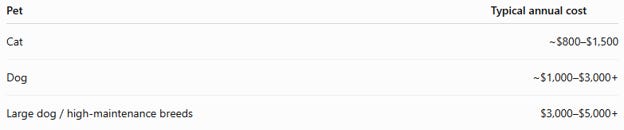
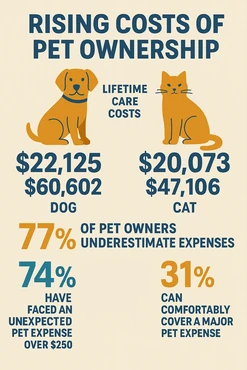
Source: https://www.consumeraffairs.com/news/rising-pet-care-costs-find-many-owners-unprepared-060325.html
I have a pet. I’ve had a few. However, I didn’t get one until other financial matters were addressed.
There’s a word for this, “priorities.”
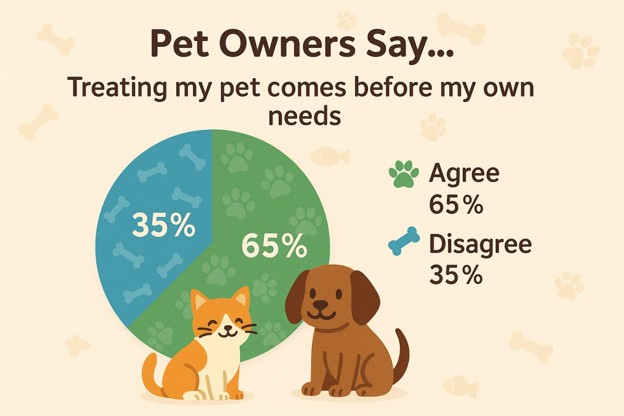
Complaining about the cost of living, housing, groceries, etc. while owning expensive pets is an example of an inability to prioritize.
How big of an issue is it?
I’d say big since “nearly 40% of pet owners recently surveyed by LendingTree said they had gone into debt because of their pet. And among households with pet debt, nearly 1 in 4 have at least $1,000 in pet debt.”
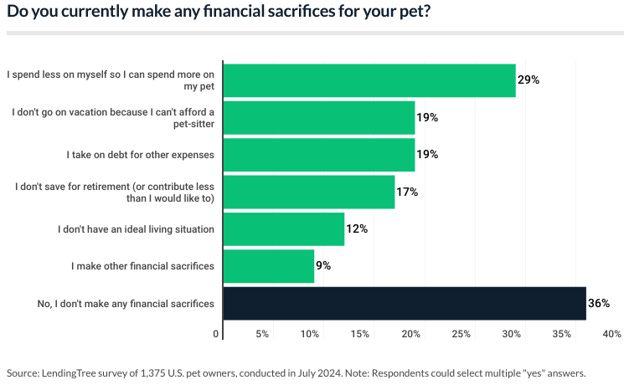
How you spend your money is your decision, just don’t bitch to me about how hard your life is.
“Pets are people!”
The second issue with “runaway pet ownership” affects more than the pet owner, it effects society at large. Let’s call it “misplaced values.”
This is where “pet parent” comes into play.
If you follow the news, you likely know that there is an immigration debate going on. This debate is influenced by declining fertility rates in the West where countries have seen rates fall below replacement level.
Pet ownership isn’t the cause, but it certainly isn’t helping. Especially when so many people identify as “pet parents” and put pet ownership, yes, ownership, on an equal footing as parenthood.
The fact that there are more pets in Australia than people came as a surprise, so I looked into a few other countries and while it’s not quite that bad, it’s not good. Especially when we compare it to the number of children each country has.
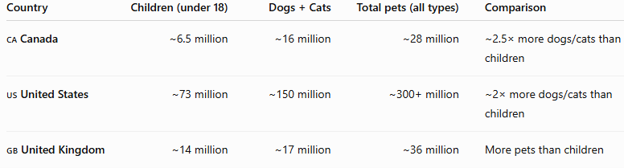
For three countries with insufficient fertility rates, having more pets than children is a disturbing sign.
It’s also getting worse as people replace having children with having pets.
Note: if you say, “fur babies,” I will have you killed.
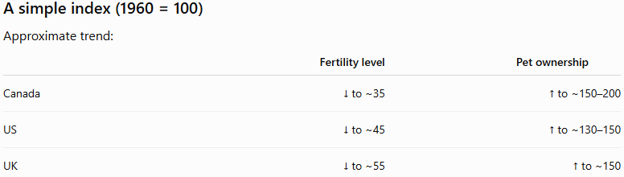
A “simple” plan
Would these countries be better off if more people had chosen children over pets?
How many more children would need to exist for their fertility rates to be above replacement?
It’s a hard question to answer. You can’t directly convert today’s child population into a fertility rate. However, you can estimate how many additional children would have been born over the past 18 years if each country had maintained replacement-level fertility (about 2.1 children per woman) instead of its actual fertility rate.
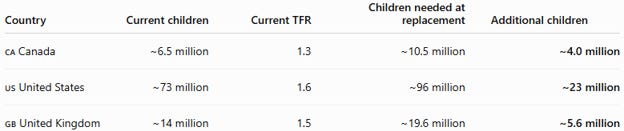
How many kids aren’t being born because “pet parents” equate cats and dogs to people?
Hard to say, but society would be better off if we had more children.
How do we change this?
I’m generally against taxes but if I thought it would fix the problem I’d suggest a very high tax on pet ownership. Given the numbers, it might even fix the budget issues at the same time.
It won’t work though. With pet ownership sitting well north of 50% it would never pass.
We’ll just have to fall back on the old tried and true methods.
Guilt and shame.
So here is a message from we “olds” to you young’uns: we’re not getting any younger and we want to be grandparents at some point.
I get it, kids are expense and you’re “not ready.”
Who ever was?
They don’t hand out books that say, “here’s how to be a parent.”
Actually, it’s worse that, they do, but they all contradict each other.
You make mistakes and you learn as you go.
Just like everyone has.
Yes, it’s hard work. And expensive.
But it’s much more rewarding than pet ownership. Something you can’t understand until you have a child.
My advice to pet owners in general and “pet parents” specifically?
Grow up!
Start having kids.
Your dog isn’t going to visit you in your old age home.
Neither will your cat. Worse, if you die alone your cat will probably eat you.
We’ll never solve the fertility crisis as long as society puts pets on equal footing as people.
So “get busy!”
I’ll even, grudgingly, allow you to say “we’re pregnant” if it will seal the deal.
Until then, I’m thinking of selling bumper stickers that say, “Save the West, punch a pet parent.”
Any takers?
Thank you for reading Hoist the Black Flag
If you enjoyed this piece, the quickest way to help is to hit the like button — it takes one second and makes a real difference to how Substack surfaces the writing.
If you’d like to do more, sharing or restacking puts it in front of readers who might never have found it otherwise. And if you’d like to support the work directly, buying a coffee or becoming a subscriber means the world.
Either way, your time and attention genuinely matter — thank you.
I think most of that cost is in the last few months of life. When I rushed my cat to the emergency vet because she was in terrible shape, they charged $2500 to tell me that she was dying. They wanted to keep her overnight -- at a cost of $3500 -- and then do scans in the morning at a cost of $1000 apiece. I was looking at minimum $7000.
I asked, "If we keep her here and do the scans, can you save her?"
The answer was, "We might be able to manage her illness for a few months."
I knew immediately that managing the illness meant that I'd be giving them thousands and thousands more dollars. She was still going to die and awful death from kidney failure.
I loved my cat. But I wasn't going to let her suffer just because I couldn't bear to say goodbye. (I've done that once, and regretted it.) I bundled her up, took her home, and she slept on my bed with me, as she always did. The next day, a very kind and compassionate veterinarian came to euthanize her while my husband and I stroked her. She died at home surrounded by people her loved her, not in a cold, sterile emergency clinic.
Veterinary medicine has now become big business, and these corporations are charging huge amounts when people show up in distress with the animal they love so much. Their greed has overcome their humanity. They've chosen to become predators rather than saviors.
I am a canine professional, with over 50 years experience across thousands of dogs, and yep, that is a huge problem. It's a dog, it's not a child, no matter that they're raised and treated much the same (including, in recent decades, the same lack of discipline and consequent family misery). It is legally property, at least for now.
The whole "pet parent" thing comes out of the "animal rights" movement (itself straight out of Marxism), which wants you to have no pets at all (in fact no animal use whatever; vegetarianism also comes out of Marxism), because "owning an animal is slavery". If pets have the same rights as humans, then anyone can take you to court on behalf of your pet and sue you for everything you're worth, and pet ownership becomes too financially risky for most people to consider (maxing out your credit card doesn't have quite the impact of the law taking your house to pay a court judgment on behalf of your cat). It's a form of class warfare designed to hit people who are immune to the usual race-and-traits class warfare. And they're walking straight into it, because good-hearted people often have trouble seeing hard choices. So far, legislators have not gone down that path, but bills have been proposed in California and elsewhere which would have that effect. "Parent" is a legal term, and legally enforceable.
And socially, those who just want to be "good people" feel pressured not to have kids, but they still have that need to nurture, and pets are still socially acceptable, provided they're all spayed and neutered (because you should not profit off slavery; the "overpopulation" meme is bogus[1]) and you give them everything you'd have otherwise lavished on your nonexistent kids.
Another effect of "animals are people" is that no animal can be euthanized for any reason. The upshot is that dangerous dogs, many with a history of multiple serious bites, are commonly offered for "adoption"[2] by "rescues" -- the whole point is to make dogs too SCARY for average people, because they've all heard stories of someone's grandma getting mauled.
A third effect is that in some jurisdictions (eg. California) you are required by law to provide any care the animal requires, at any cost. It cannot be euthanized for expensive health issues. If you cannot do so, the animal must be relinquished to the diagnosing veterinarian. Yes, that is CA state law (tho I do not know of any cases where it has been enforced).
So: It sounds like kind-hearted people "just doing the right thing" but is in fact part of a long-running plan to eliminate all animal use and ownership. And it all sounds so good to those who just want to be good people, that they cheer it on with no understanding of the long-term consequences.
___
[1] Breeders produce about 400k puppies per year, down from 700k ten years ago and 1.2M twenty years back. About 90% of pets are required by law to be spayed/neutered, precisely so they won't impact rescue sales. Rescues import around 2 million dogs per year, up from the CDC's figure of 1.2M in 2007 (many street dogs, but many purpose-bred for export to the rescue trade, and in Turkey, pet theft for sale to rescues is a cottage industry). If one peruses the financial disclosures required of 501(c)3 charities, as rescues are classed, and understands that "administrative expenses" is charity-speak for "owner's salary" one quickly discovers that rescue is WAAAAY more profitable than breeding.
(Breeders have expenses, and only healthy puppies are salable. Rescues get their expenses paid by donations, which they get by tugging heartstrings over some "abandoned" or serious-health-problem animal that they then sucker someone into "adopting".)
[2] It's not adoption, it's a lease. The contracts all say that the "rescue" retains ownership of the animal. (But you get to pay all its expenses, and in the event you can't keep it, you can only relinquish the animal back to the ''rescue".)