
Remigration
How the rule of law ends.

Like most political movements, the New Right is an umbrella encompassing many beliefs; it is a loose ideological cluster that distinguishes itself from both mainstream conservatism and older far-right movements.
I don’t consider myself a “New Rightist,” but then I don’t consider myself to be a conservative and that’s what many people call me.
Would some form of Venn diagram be helpful? Maybe, but I have neither the time nor the inclination to create one. I’ll go on telling you what I believe, and you can put whatever label you like on it.
That said, I am sympathetic to some of the New Right’s complaints. What respect I had for NGOs, supranational institutions (EU, UN, WEF), and managerial elites largely vanished during the COVID-19 era. Likewise, I find the progressive position that everyone can be proud of their heritage and culture, except white people to be moronic. I see no issue with people of Western nations being proud of their heritage and preserving their cultures and homelands.
Where we disagree is in our assessment of liberalism.
Are liberal democracies failing to address major cultural, social, and political issues? Yes. Is liberalism dead? No.
Rejecting markets, individualism, and Enlightenment rationalism while embracing soft authoritarianism reeks of communism. It matters little that the goals differ if the institutional approaches are identical — capturing and dismantling existing institutional constraints rather than working within them.
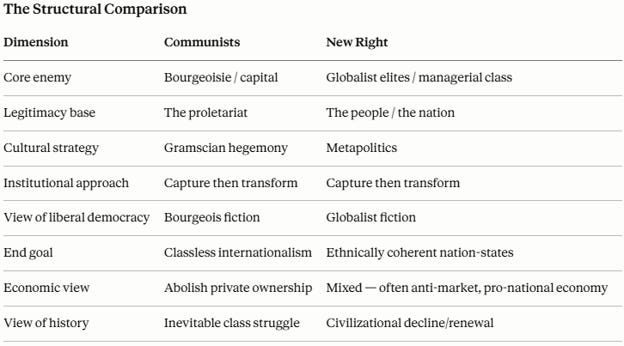
In this age of illegal and mass immigration, Remigration (sometimes called repatriation) may be the most obvious of the New Right’s illiberal methods. Unlike deportation which, while contested, seeks to enforce national borders and laws and is accepted by international law, remigration seeks to overturn or ignore existing citizenship laws in order to enforce ethnic “standards.”
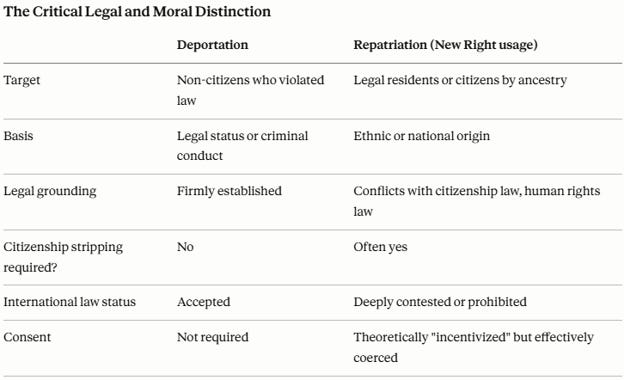
While I largely agree with the New Right’s position that levels of immigration, legal and otherwise, have done more harm than good over the last decade, I do not support repatriation for two reasons.
The first is that those who became citizens during the age of mass immigration did so under existing laws passed by a legally elected government. The law is the foundation of society.
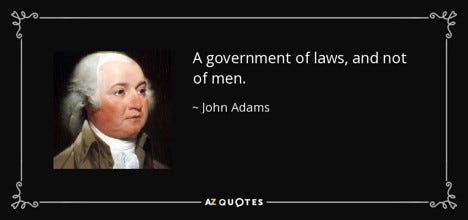
That is the legal argument against remigration. The second reason is more selfish; it is one I support for my own safety’s sake; once it is decided that we are a nation of men, not laws, we open the door for anyone to be repatriated.
Supporters of remigration see the sentence “compelled return of legal immigrants or naturalized citizens based on ethnicity” and all they see is “ethnicity.” However, the word they should be focused on is “citizens.” If citizenship can be stripped from one citizen, it can be stripped from another, and it would be naïve to think that how long a person has been in the country would matter. When the New Right is done with non-Europeans and turns on you for being the wrong religion or the wrong type of European, what will your defense be, “I have rights?” Newcomers have rights too and it didn’t help them.
First they came for the Communists
And I did not speak out
Because I was not a Communist
Then they came for the Socialists
And I did not speak out
Because I was not a Socialist
Then they came for the trade unionists
And I did not speak out
Because I was not a trade unionist
Then they came for the Jews
And I did not speak out
Because I was not a Jew
Then they came for me
And there was no one left
To speak out for me
-- Martin Niemöller
I will not take the position that there is nothing wrong with society or with how liberalism is currently functioning. I wouldn’t have a political Substack if I believed that. However, I have yet to see a convincing argument that the solution to our problems is to discard liberalism in favor of a strongman, a return to absolute monarchy, or some other form of arbitrary rule.
There is much in Canada, and the West, which disturbs me, but I am not aware of any form of government yet tried that has been more successful in improving the lot of humanity than liberal free-market democracy.
If you remain confused as to why I support liberalism over illiberalism and a government of laws over a government of men, despite my many disagreements with the current government, I will leave you with this exchange:
“William Roper: “So, now you give the Devil the benefit of law!”
Sir Thomas More: “Yes! What would you do? Cut a great road through the law to get after the Devil?”
William Roper: “Yes, I’d cut down every law in England to do that!”
Sir Thomas More: “Oh? And when the last law was down, and the Devil turned ‘round on you, where would you hide, Roper, the laws all being flat? This country is planted thick with laws, from coast to coast, Man’s laws, not God’s! And if you cut them down, and you’re just the man to do it, do you really think you could stand upright in the winds that would blow then? Yes, I’d give the Devil benefit of law, for my own safety’s sake!”
― Robert Bolt, A Man for All Seasons: A Play in Two Acts
Thank you for reading Hoist the Black Flag
If you enjoyed this piece, the quickest way to help is to hit the like button — it takes one second and makes a real difference to how Substack surfaces the writing.
If you’d like to do more, sharing or restacking puts it in front of readers who might never have found it otherwise. And if you’d like to support the work directly, buying a coffee or becoming a subscriber means the world.
Either way, your time and attention genuinely matter — thank you.
I totally agree with you, but I also think it's going to be very difficult to prevent the pendulum from swinging too far in the other direction, whenever it happens. It is certainly a concern to me, even after going through all the hoops to legally come to Canada good 30+ years ago, paying my taxes every since, becoming a citizen, raising my kids with Canadian values, and being as fed up as anyone else with the consequences of the extreme quantity of people let in the country in the last few years.
While your position has great integrity, a contrary view is that the problems are so intractable that extralegal action is necessary. “He is sovereign, who decides the exception” is a (slightly) more palatable way of putting this.